
Turnkey Home Construction Pros and Cons in India (2026): Rates, Contract Clauses & the Fine Print
Turnkey home construction in India: published 2026 rates, contract clauses that protect you, and when turnkey beats the labour-contract route.
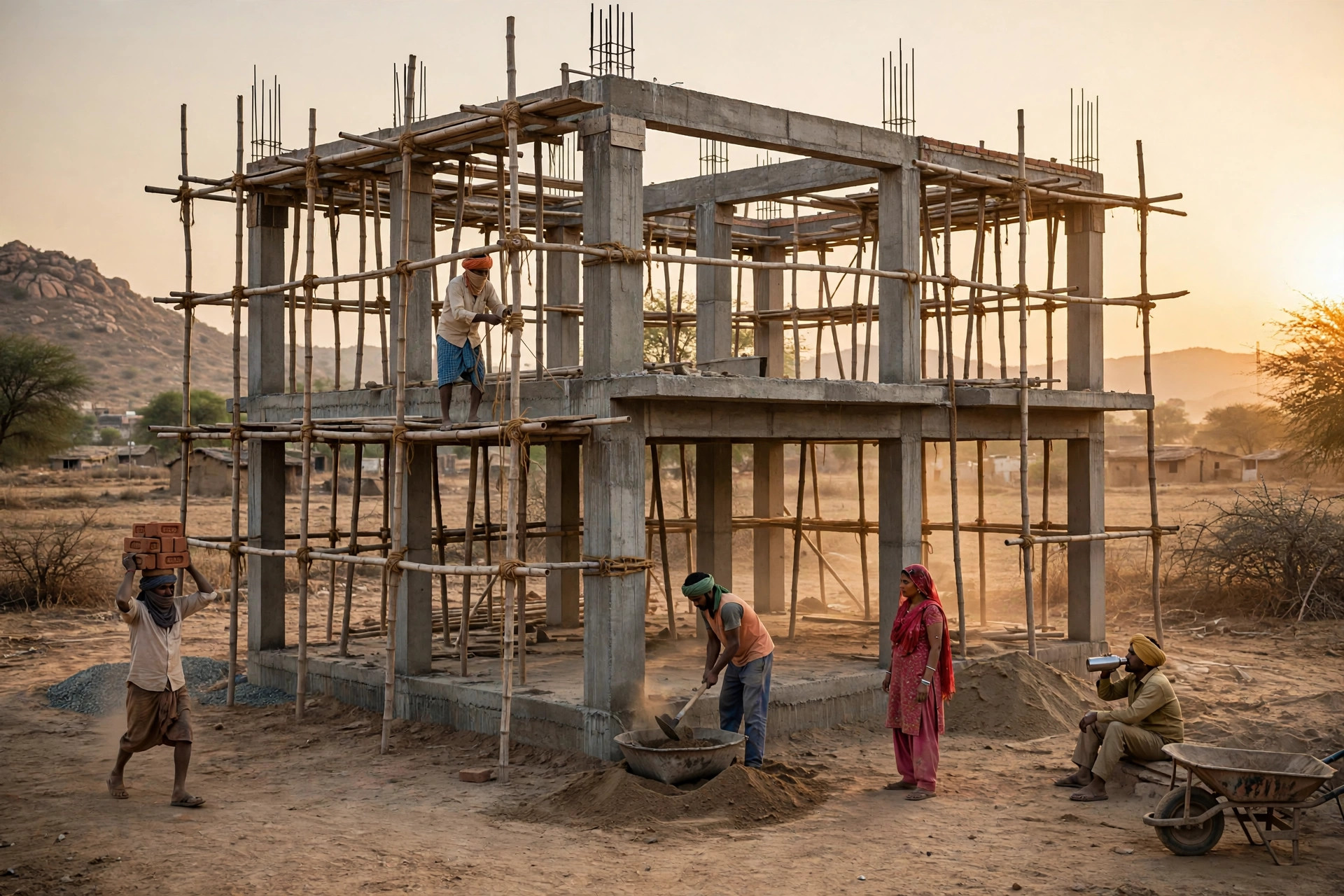
Ask ten Ajmer families how they built their house and you will hear two religions. One swears by the labour-contract route — buy your own cement, hire your own mistri, watch every rupee like a hawk. The other swears by the contractor who took everything off their plate and handed back a finished key. If you are weighing turnkey home construction pros and cons in India right now, this guide is the neutral ground: what turnkey actually means in the Indian market, what it genuinely costs in 2026, the contract clauses that decide whether it works, and the traps that hide in the fine print.
Short answer: In a turnkey contract, one contractor takes design, approvals, material procurement and construction, and hands you the key at a fixed per-sq-ft or lump-sum price. Pros: single-point accountability, cost certainty from day one, near-zero management load. Cons: you pay for that convenience, mid-project changes are hard to price without item rates, and some "turnkey" quotes quietly exclude finishing, approvals or the compound wall. Published 2026 Indian turnkey rates run roughly ₹2,300–4,000 per sq ft (NoBroker), lower in tier-2 cities. Read the exclusions list before the rate card — that is where turnkey deals are won or lost.
Turnkey Home Construction Pros and Cons in India: What the Term Really Means
A Hindi construction channel, GP Design & Construction, puts the definition plainly in its video "Advantages and disadvantages of Turnkey Contract in house Construction": turnkey means handing over the *entire* responsibility — from design to construction, "and sometimes even furnishing" — to a single contractor. You pay per the agreed plan; you enter the finished house.
The Indian home-building site Happho lays out the four contract models homeowners actually choose between: (1) turnkey/lump-sum, (2) labour contract, (3) unit-price contract, and (4) cost-plus percentage. Under turnkey, the whole responsibility — architectural and engineering design, liasoning (getting approvals), material procurement, and construction — transfers to the contractor. Sometimes it is construction-only turnkey, where design is done by a separate agency. The owner gives detailed requirements and material specifications; the contractor quotes a fixed price or a per-sq-ft rate of built-up area covering everything till handover; payment terms are mutually agreed. That "covering everything" phrase is doing a lot of work — keep it in mind when we reach the exclusions section.
Published Turnkey Rates in India (2026): What the Market Actually Quotes
Nobody can tell you *your* turnkey rate from a blog post — firms price on plot size, floors, specifications and city. But published 2026 bands exist, and they frame the negotiation:
| Source / market | Turnkey rate per sq ft | Notes |
|---|---|---|
| NoBroker (blog, updated Apr 2026) | ₹2,300–4,000 | All-in: materials, labour, contractor margin; popular with owners wanting minimal management |
| Kerala home-building guide (2025) | ₹2,500–4,000 | Contractor handles labour, materials, supervision; owner "just turns the key" |
| Bangalore standard tier (published Oct 2026) | ₹2,000–2,400 | Premium ₹2,800–3,500; ultra-luxury ₹4,000+ |
| JSW One Homes' own builds | ₹2,000–3,000 | Coimbatore ₹2,000 (1,200 sq ft, ₹24L, 9 months); Hyderabad ₹2,600 (1,500 sq ft, ₹39L, 9 months); Bangalore ₹3,000 (1,800 sq ft, ₹54L, 11 months) |
| Jaipur — nearest published tier-2 proxy | ₹1,500–2,200 | NoBroker; metro builds can cost ~50% more than tier-2 cities |
For contrast, the labour-only rate published by NoBroker is ₹350–550 per sq ft — but that excludes *all* materials: the owner buys every bag of cement, manages quality control and scheduling. That is cheaper on paper and heavier on your life, which is exactly the trade-off.
Two caveats before you budget. First, no Ajmer-specific turnkey rate is published anywhere we could verify — Jaipur is the closest published tier-2 proxy, labelled as such. Second, one widely published warning: add 12–18% to any turnkey quote for the typical exclusions (published Bangalore breakdown, Oct 2026) before comparing it to anything. And NoBroker notes premium tiles, modular kitchens and designer fittings can push finishing costs 40%+ higher than the base band. For the full per-sq-ft maths on how construction costs stack up in tier-2 cities, see our 2026 tier-2 construction cost guide and the Ajmer house-building cost breakdown.
The Pros of Turnkey Home Construction
One throat to choke. GP Design & Construction's own list leads with it: a single contact person for all project matters streamlines communication, and the contractor handles every aspect — hassle-free for the owner, saving time and effort. Happho agrees: risk to the owner is low because the *whole scope* sits with the contractor.
Cost certainty from day one. Happho's second advantage: fixed construction costs with very low cost variability. The turnkey number is locked against a written specification, so material-price spikes during your build are the contractor's problem, not yours. NoBroker's FAQ puts it the same way: turnkey is generally more expensive upfront but gives cost certainty from the start while reducing management hassles.
Specialist quality is possible. Experienced turnkey contractors deliver with a team of specialists — engineers, supervisors, procurement — that a single-family owner can rarely assemble alone (GP Design & Construction). The better turnkey firms now publish milestone-based build timelines too: JSW One Homes' own published projects ran 9 months for a ground-floor build, 11 for G+1, 13 for G+2 — useful as a sanity check when any contractor quotes you "six months" for a two-storey house.
The Cons of Turnkey Home Construction in India
You pay for the convenience. The same channel's first con is blunt: turnkey can be more expensive, with a real risk of overpaying or budget trouble if you sign a loose quote. Honest note: no single published figure exists for the "turnkey premium" over labour-contract building — anyone quoting you one invented it. Compare a turnkey quote against (materials + labour + your management time), never against the labour-only rate alone, because that rate buys zero materials.
The trust risk is the whole game. Choosing a trustworthy contractor is crucial — a bad one can mean real financial loss, not just delays (GP Design & Construction). Some contractors compromise quality if your project is not their top priority, so verifying past built work is not optional. The Kerala guide's prescription: get at least three contractor quotes and have a civil engineer review them before signing.
The change-order trap. Happho flags the structural weakness of lump-sum turnkey: it is very difficult to quantify changes in scope or specifications mid-project, because item rates do not exist in the contract. The workaround they recommend is to agree item rates beforehand, even inside a turnkey deal — and the project must be fully designed before work starts, since "design it as we build" and fixed pricing cannot coexist.
The exclusion trap. This is where turnkey deals actually go wrong. Some "turnkey" contracts cover the *structure only* — foundation, walls, roof — with finishing under a separate agreement (Kerala guide). A published Bangalore breakdown of reputable turnkey contracts lists what is *almost universally excluded*: municipal sanction charges and the architect's stamp fee, borewell and overhead water tank, generator provision, compound wall and gate, landscaping, furniture and furnishings, plus "site surprises" like soil conditions and utility connections. Budget that 12–18% add-on before you compare quotes.
The labour-contract alternative deserves a fair hearing too. Happho's case for it: you save money buying materials yourself, quotations are easy to compare, and changing the design mid-build is simple. Its case against: the contractor has no incentive to use materials efficiently (wastage is your money), can disown defects as "faulty owner-supplied materials", the total cost stays uncertain till the end, and the management load is entirely yours. The Economic Times' 2008 guidance still holds: the labour route suits owners who want strict quality standards and have the time to enforce them.
The Payment Schedule That Protects You
Published Indian norms are remarkably consistent. Structure your payments like this, and a turnkey deal becomes much safer:
| Stage | Published norm | Why it matters |
|---|---|---|
| Advance to start work | 10–20% | Enough to mobilise; never the full amount |
| Stage payments | Linked to milestones — foundation, walls, roofing | You pay for built work, not promises |
| Retention | 5–10% held back | Released only when the house is complete and defects fixed |
| Defect liability | At least 1 year after handover | Contractor fixes cracks, leaks and defects free |
Sources: Kerala home-building guide (advance, stages, retention, 1-year repair responsibility). Some organised turnkey builders go further — JSW One Homes describes escrow milestone payments released only after inspection and owner approval, with a 1-year workmanship warranty and 5-year structural warranty on their own projects. Whether or not your contractor offers escrow, the principle is the same: money follows verified progress, and a chunk stays back until the defects show themselves.
Contract Clauses That Decide Whether Turnkey Works
The Economic Times' long-standing advice is a two-part contract: (1) the structure on a per-sq-ft basis, built against the architect's structural and working drawings; (2) fittings, fixtures and furnishings on an item-rate basis with specified make, brand and size plus separate base rates. Their worked example: marble at a base rate of Rs 150 per sq ft over 600 sq ft = Rs 90,000 adjustable against the contractor's payment — you can upgrade the marble later and pay only the difference. That single mechanism defuses the change-order trap.
The clause checklist the same ET piece prescribes — still the standard today:
- Parties involved and their authority to appoint or sub-contract
- Quality of material — brand, grade, specifications in writing
- Timeframe for completion of the various phases, with penalty terms for delays
- Payment terms tied to milestones
- Escalation clauses (what happens if the project runs long)
- Liability of the respective parties
- Who provides the material — and who bears wastage
- Fittings specifications and timelines for inspection
Add the Kerala guide's practical extras: list every material (cement brand, tile type) and every task; include dispute-resolution steps; get witness signatures; never build on a verbal agreement. On the design side, remember the approvals the contractor is liasoning for — our Ajmer naksha approval guide walks through the ADA/Nagar Nigam process your contractor should be handling, and if you are still choosing who designs the house, read the architect vs civil engineer comparison first.
When Turnkey Wins — and When Labour Contract Is the Better Call
Choose turnkey when: you live elsewhere or cannot visit the site weekly; you want cost certainty more than the lowest possible rupee; you have no trusted contractor and mistri network; your design is frozen and you want a fixed timeline. NRIs building in Ajmer are the classic turnkey case — distance makes daily supervision impossible.
Choose labour contract when: you live near the plot and can supervise; quality control matters more to you than convenience (the ET rule); you have time to source materials and negotiate; or your design is still evolving — labour contracts absorb changes gracefully, turnkey contracts punish them. Either way, get the design right before the first brick: an architect's fee is the cheapest insurance in the whole project.
Does a turnkey contractor also handle the naksha approval?
Often yes — liasoning for approvals is part of the standard turnkey scope in Happho's definition — but confirm it in writing, because sanction charges and the architect's stamp fee are among the most commonly excluded items in published turnkey breakdowns. If the contractor "forgets" the approval, the delay is yours.
Frequently Asked Questions
How much does turnkey home construction cost per sq ft in India in 2026?
Published 2026 bands: NoBroker quotes ₹2,300–4,000 per sq ft all-in (materials, labour, contractor margin); a Kerala building guide quotes ₹2,500–4,000; builder-published project costs run lower in smaller cities (JSW One Homes: ₹2,000–3,000 across Coimbatore, Hyderabad and Bangalore). Jaipur, the nearest published tier-2 proxy, is ₹1,500–2,200. Add 12–18% for typical exclusions.
Is turnkey construction cheaper or more expensive than a labour contract?
More expensive on paper: labour-only rates run ₹350–550 per sq ft but exclude all materials plus your entire management time (NoBroker). Turnkey bundles materials, labour, supervision and the contractor's margin into one number. No single published "premium percentage" exists — compare a turnkey quote against materials + labour + your time, never against the labour rate alone.
What should a turnkey home construction contract include in India?
A written, signed agreement listing material brands and specifications, phase-wise timelines with penalty terms, milestone-linked payment terms, an escalation clause, liabilities of both parties, who supplies materials, and inspection timelines (Economic Times). Use the two-part structure: structure on per-sq-ft, fittings on item rates with base rates. Never build on a verbal agreement.
What does turnkey construction usually exclude?
Frequently excluded: municipal sanction charges and the architect's stamp fee, borewell, overhead water tank, compound wall and gate, landscaping, furniture and furnishings, and soil-condition surprises (published Bangalore breakdown). Some "turnkey" deals cover the structure only (Kerala guide). Get the exclusion list in writing and budget 12–18% extra before comparing quotes.
How are turnkey construction payments made in India?
The published norm: 10–20% advance to start, stage payments tied to construction milestones (foundation, walls, roofing), 5–10% retention held until completion and defects are fixed, and at least one year of defect liability for cracks and leaks (Kerala home-building guide). Never pay the full amount upfront — money should follow verified progress.
Book Site Consultation
The turnkey decision is made or broken before the contract — in the design freeze, the specification sheet and the exclusions list. One measured site visit settles what a phone quote never can: soil, levels, setbacks and access. Book a site consultation and Design Plus will measure your Ajmer plot, freeze the design with you on 2D first, and help you read any contractor's turnkey quote line by line — so you sign a contract where the rate, the materials and the exclusions are all in writing before the first brick is laid.
Planning a project in Ajmer?
Get a free site consultation with our architects — honest scope, transparent pricing, no obligation.
Book Free Site Consultation