
Construction Cost per Sq Ft in India 2026: What Tier-2 Cities Actually Pay
Construction cost per sq ft in India 2026: tier-2 city rates ₹1,100–₹2,800 with real city tables, material breakdowns and hidden costs.
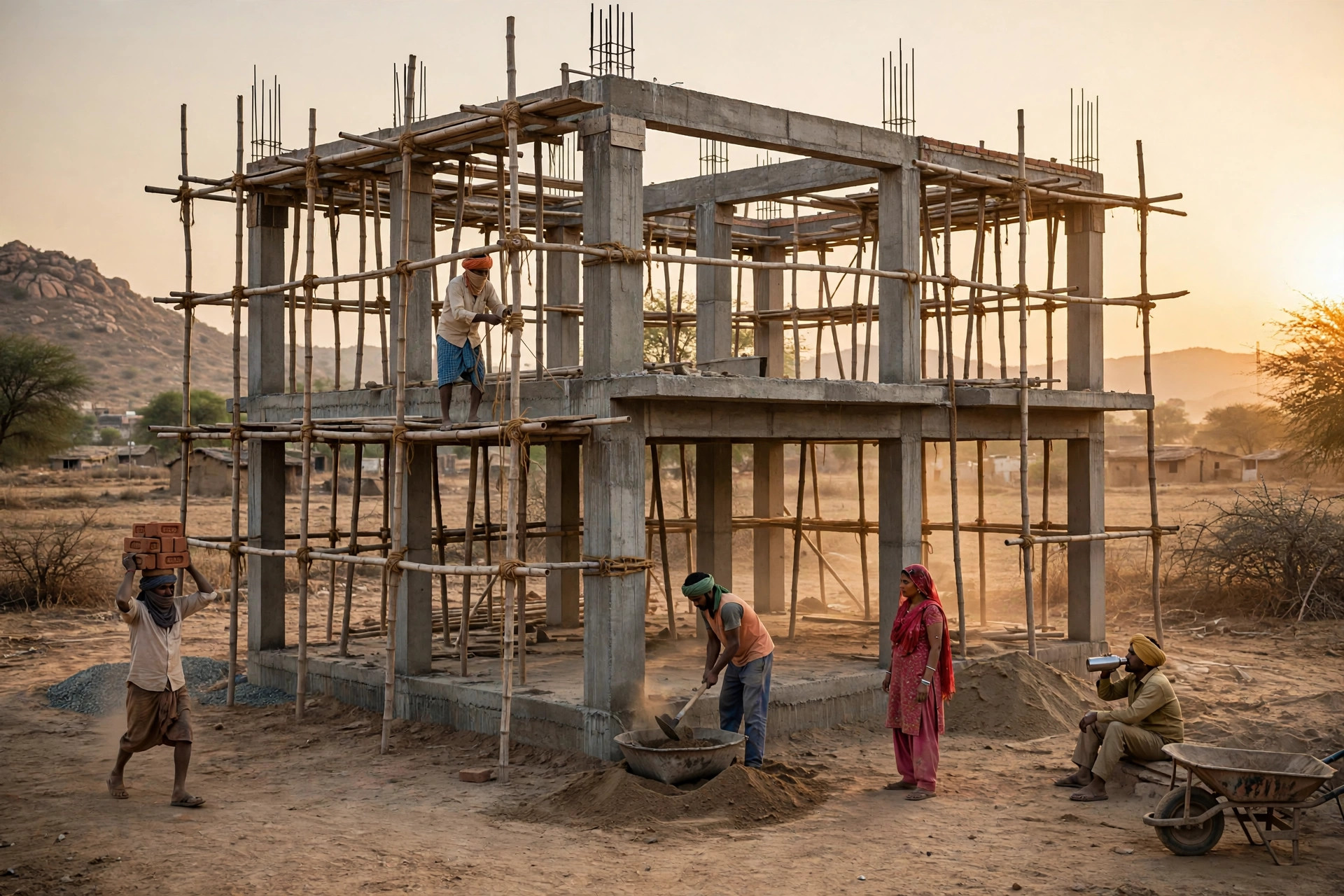
Ask ten people about the construction cost per sq ft in India in 2026 and you will get ten answers — most of them wrong in the same direction: under. A contractor quotes ₹1,500 per sq ft and three months later the same person is borrowing for the slab. The problem is not dishonesty so much as contextlessness: a per-sq-ft rate means nothing without knowing which city, which specification level, and what is excluded. This guide pins down the real 2026 numbers for India's tier-2 cities — Jaipur, Lucknow, Coimbatore, Indore and the towns around them — where most of India is actually building.
Short answer
In 2026, a budget-specification home in a tier-2 Indian city costs roughly ₹1,100–₹1,800 per sq ft, a standard-specification home ₹1,400–₹2,500 per sq ft, and a premium build ₹2,000–₹4,500 per sq ft — about 20–30% less than the same specification in a metro. For a 1,500 sq ft home, that means roughly ₹17–27 lakh at the budget end and up to about ₹38 lakh at the standard end, before land, interiors and architect fees.
What a per-sq-ft construction rate actually covers
Before comparing any two numbers, know what a contractor means when he says "₹1,800 per sq ft". In the Indian market, that figure normally covers the complete structure plus basic finishing: foundation, RCC frame, brickwork, plaster, flooring, doors and windows, electrical and plumbing, and painting. It is calculated on built-up area — the total constructed floor area, not the plot size.
What it usually does not cover: the land and stamp duty, architect and structural engineer fees (typically 2–5% of construction cost), compound wall, borewell or rainwater harvesting, solar panels, interiors and modular furniture, landscaping, and statutory fees. A 2026 JK Cement guide puts the hidden extras at utility connections ₹50,000–2 lakh, compound wall ₹1–3 lakh, an elevator ₹3.5–8 lakh if needed, parking and landscaping ₹75,000–2 lakh, and interior finishing at 25–40% extra on top of the build cost. Statutory fees, GST on materials and services, and mandatory insurance add another 3–5%. Anyone who hands you one all-in number without listing these exclusions is quoting a fantasy — add your own 10–15% contingency on top of whatever you are told.
Construction cost per sq ft in India 2026: tier-2 city rate tables
Rates vary 30–50% across India by location, and tier-2 cities consistently land 20–30% below metros because labour is cheaper, material transport is shorter, and land and overheads are lower. The tables below combine 2026 published estimates from Construction Estimator India, Mr Civil Engineer, Comaron, GharKaBudget and AECORD — all of which track tier-2 markets specifically. Treat each band as a range you will actually hear quoted, not a guarantee.
Budget specification (simple design, local materials, standard fittings)
| City / region | Budget (₹/sq ft) |
|---|---|
| Lucknow | 1,620–1,980 |
| Jaipur | 1,740–2,100 |
| Lucknow–Coimbatore band (general tier-2) | 1,400–1,800 |
| Indore / Bhopal | 1,000–1,400 (economy–standard) |
| Smaller towns | 850–1,150 |
| Tier-2 average | 1,100–1,800 |
Standard specification (good tiles, branded fittings, modular kitchen, branded cement and steel)
| City / region | Standard (₹/sq ft) |
|---|---|
| Jaipur (G+2 mid-range) | 2,280–2,880 |
| Lucknow (G+2 mid-range) | 2,160–2,760 |
| Lucknow–Coimbatore band | 1,900–2,500 |
| Indore / Bhopal | 1,400 |
| Smaller towns | 1,150 |
| Tier-2 average | 1,400–2,500 |
Premium specification (imported or high-end materials, custom design, automation)
| City / region | Premium (₹/sq ft) |
|---|---|
| Jaipur (G+3+) | 3,180–4,080 |
| Lucknow–Coimbatore band | 2,800–4,500 |
| Indore / Bhopal | 2,000 |
| Smaller towns | 1,700 |
| Tier-2 average | 2,000–4,500 |
The cheapest credible tier-2 construction in 2026 sits around ₹850–1,100 per sq ft in smaller towns, and the national average for basic specification runs ₹1,200–1,800 per sq ft, mid-range ₹1,800–2,500, premium ₹2,500–3,500-plus. Two forces moved the needle this year: construction estimators tracking 2026 report roughly 10% material inflation year-on-year, with steel up about 8% and cement up about 12% — so a quote recycled from 2024 will not hold.
Construction cost per sq ft: why tier-2 cities run 20–30% below metros
The same 1,500 sq ft home that costs ₹1,900 per sq ft in a tier-2 city easily touches ₹2,400–2,600 per sq ft in Delhi-NCR or Bangalore and ₹2,800-plus in Mumbai. Four things drive the gap:
- Labour. Metro mason day-rates and supervision costs run substantially higher; Mr Civil Engineer notes 2026 labour-to-material ratios have flipped to roughly 60:40 (labour:material), up from 50:50 before 2022, because skilled workers are scarce everywhere — and scarcest in metros.
- Transport and logistics. Every bag of cement and every truck of aggregate travels further into a metro, and site storage and access cost more.
- Regulation and overhead. Stricter bylaws, longer approval cycles and higher contractor overheads in metros get priced in.
- Land. Not part of the per-sq-ft rate, but land prices push metro buyers toward smaller plots and taller structures — and G+4 construction adds roughly 28% for lifts, stairs and heavier structure.
The practical lesson for someone building in Ajmer, Jaipur, Lucknow or Indore: your local contractor is not low-balling when his rate looks 25% under a Delhi quote. He is pricing a genuinely cheaper market. Verify the specification, not just the headline number.
What the rate is made of: a forensic breakdown
Per-sq-ft rates hide a bill of quantities inside them. To see what you are actually paying for, look at component-level costs. A 2026 analysis by Mr Civil Engineer breaks a standard-quality build down per sq ft: site preparation and foundation ₹150–300, RCC frame (columns, beams, slabs) ₹300–600, masonry ₹200–400, plastering ₹100–200, flooring and tiles ₹150–300, doors and windows ₹100–250, painting and putty ₹80–150, electrical and plumbing ₹150–300, waterproofing and miscellaneous ₹50–100 — totalling ₹1,800–2,800 for civil plus finishes.
Then there is the forensic audit that went viral in the construction community this year. Architect Shadab of Architecture Opinion performed a line-by-line "forensic audit" of a 1,800 sq ft (30×60 ft) Class-B home on his YouTube channel in 2026, and the material numbers are instructive: steel (TATA/Jindal) roughly 6,300 kg — about 3.5 kg per sq ft — at ₹68/kg came to ₹4.28 lakh; cement (UltraTech/ACC) roughly 810 bags — about 0.45 bags per sq ft — at ₹425/bag came to ₹3.44 lakh; labour at ₹320 per sq ft came to ₹5.76 lakh. His all-in reality check for that house: roughly ₹44 lakh. His broader rule of thumb from the same episode: a first floor costs only about 80% of the ground floor to build, because the foundation and site setup are already paid for.
Material prices move, so anchor your planning to quantities, not quotes. For reference, 2026 published snapshots put cement at ₹350–420 per bag for PPC (₹440–480 for premium UltraTech/ACC/Ambuja, ₹380–420 for regional brands), and a 1,000 sq ft house needs roughly 350–400 bags of cement. When a contractor quotes far below these quantity-driven figures, the saving has to come from somewhere — thinner sections, unbranded steel, or labour he is not paying properly.
Five things that push your rate up — and by how much
- Complex design. Curved walls, large cantilevers, double-height spaces and fancy elevations add 15–25% to the rate. Every corner costs money; a clean rectangle is the cheapest shape to build.
- Material grade. The jump from budget to premium specification is the single biggest swing — ₹1,200 to ₹2,500-plus per sq ft at the national level. Branded steel, premium cement, vitrified or marble flooring instead of ceramic, and branded sanitary and electrical fittings each stack.
- Height. Going from G+1 to G+3 adds roughly 20% for extra RCC; G+4 adds about 28% for lifts and stairs. Build only what you need.
- Turnkey vs item-rate. A turnkey contractor adds 15–20% margin but handles everything; item-rate contracting saves about 10% — if you can supervise properly.
- Soil and foundation. Poor soil means deeper, wider footings, and foundation work is the hardest cost to revise mid-project. This is exactly why soil testing belongs in the budget from day one, not as an afterthought.
Six ways to hold the rate down (without cutting corners)
- Take at least three quotes. Rates vary 15–25% between contractors for identical specifications. The cheapest quote is not the winner — the one whose quantities you can verify is.
- Buy key materials yourself. Ask your contractor for a material schedule and buy cement, steel and tiles directly from dealers. Contractors typically mark materials up 10–20%.
- Keep the plan simple. One rectangle, minimal cantilevers, straight staircases. You save on structure, shuttering and labour simultaneously.
- Lock material prices. Steel and cement fluctuate through the year; get price-lock agreements for major materials before excavation starts.
- Build vertically, finish in phases. Once the foundation is done, an additional floor costs less per sq ft than expanding the footprint. And you can complete the structure and basic finishing first, then upgrade tiles, woodwork and fixtures later.
- Use online calculators, then add a buffer. UltraTech and NoBroker calculators give reasonable starting estimates — then add a 10–15% contingency for site-specific surprises, because there are always site-specific surprises.
How to read a tier-2 contractor's quote
When the quote arrives, run it through this filter before signing. First, check that the specification is written into the quote — brand of steel, grade of cement, flooring type — because "₹1,800 per sq ft" without a specification is a blank cheque. Second, separate grey structure from finishing in the bill; you cannot compare two quotes unless both draw the line in the same place. Third, confirm the exclusions list — compound wall, water and electricity connections, architect fees, interiors — and price those separately so the "budget" is the real budget. Fourth, ask for the labour rate per sq ft and the material quantities per sq ft (bags of cement, kg of steel); quantity-based quotes are auditable, flat numbers are not. Our 2026 house construction cost guide for Ajmer walks through a complete Ajmer-specific example, our architect fees guide explains what design fees buy you, and our structural engineer guide covers why the engineer should be hired before the plan is frozen.
FAQs
What is the construction cost per sq ft in tier-2 cities of India in 2026?
Roughly ₹1,100–₹1,800 per sq ft for budget specification, ₹1,400–₹2,500 for standard, and ₹2,000–₹4,500 for premium. These bands cover Jaipur, Lucknow, Coimbatore, Indore and similar cities, excluding land, interiors, compound wall and architect fees. Always confirm the specification behind the number — the rate is meaningless without it.
How much does a 1,000 sq ft house cost to build in a tier-2 city in 2026?
About ₹11–18 lakh for budget specification and ₹14–25 lakh for standard, including structure and basic finishing but excluding land. One detailed 2026 video breakdown put a 1,000 sq ft house at roughly ₹18 lakh all-in (about ₹1,800 per sq ft). Interior finishing adds 25–40% on top, and you should budget a 10–15% contingency.
Why is construction cheaper in tier-2 cities than in metros?
Three reasons: cheaper skilled labour, shorter material transport distances, and lower contractor overheads and regulatory friction. Published 2026 estimates put tier-2 cities 20–30% below metros for the same specification — for example, a home that costs ₹1,900 per sq ft in a tier-2 city can touch ₹2,400–2,600 per sq ft in Delhi-NCR or Bangalore.
What is included in a per-sq-ft construction rate?
Normally the structure plus basic finishing: foundation, RCC frame, brickwork, plaster, flooring, doors, windows, electrical, plumbing and painting — on built-up area. Excluded unless stated: land and stamp duty, architect and structural engineer fees (2–5% of construction cost), compound wall, utilities connections, interiors, landscaping, solar, and statutory fees and GST.
Is the first floor really cheaper to build than the ground floor?
Yes — roughly 80% of the ground floor's cost, per a 2026 forensic cost audit by architect Shadab (Architecture Opinion) of an 1,800 sq ft home. The foundation, site setup and soil work are already paid for on the ground floor; upper floors reuse them. The saving shrinks if the upper floor needs a stair hall, lift, or heavier structure.
How much contingency should I keep for house construction?
Minimum 10–15% of the total estimated cost, say 2026 construction guides. Contingency covers soil surprises, material price swings, design changes and the exclusions people forget — utility connections (₹50,000–2 lakh), compound wall (₹1–3 lakh), statutory fees and GST (3–5%). Treat a quote with zero contingency as incomplete, not competitive.
Ready to build with numbers instead of guesswork? Book a Site Consultation — we will study your plot, your specification level and your budget, price the structure and finishes honestly, and give you a quantity-based estimate your contractor can actually build from.
Planning a project in Ajmer?
Get a free site consultation with our architects — honest scope, transparent pricing, no obligation.
Book Free Site Consultation