
Borewell Cost in Ajmer for House Construction: Per-Foot Rates, Depth and Total Budget
Borewell cost in Ajmer for house construction: 2026 per-foot rates, ideal depth, casing, pump and total budget, plus permits and yield tests.
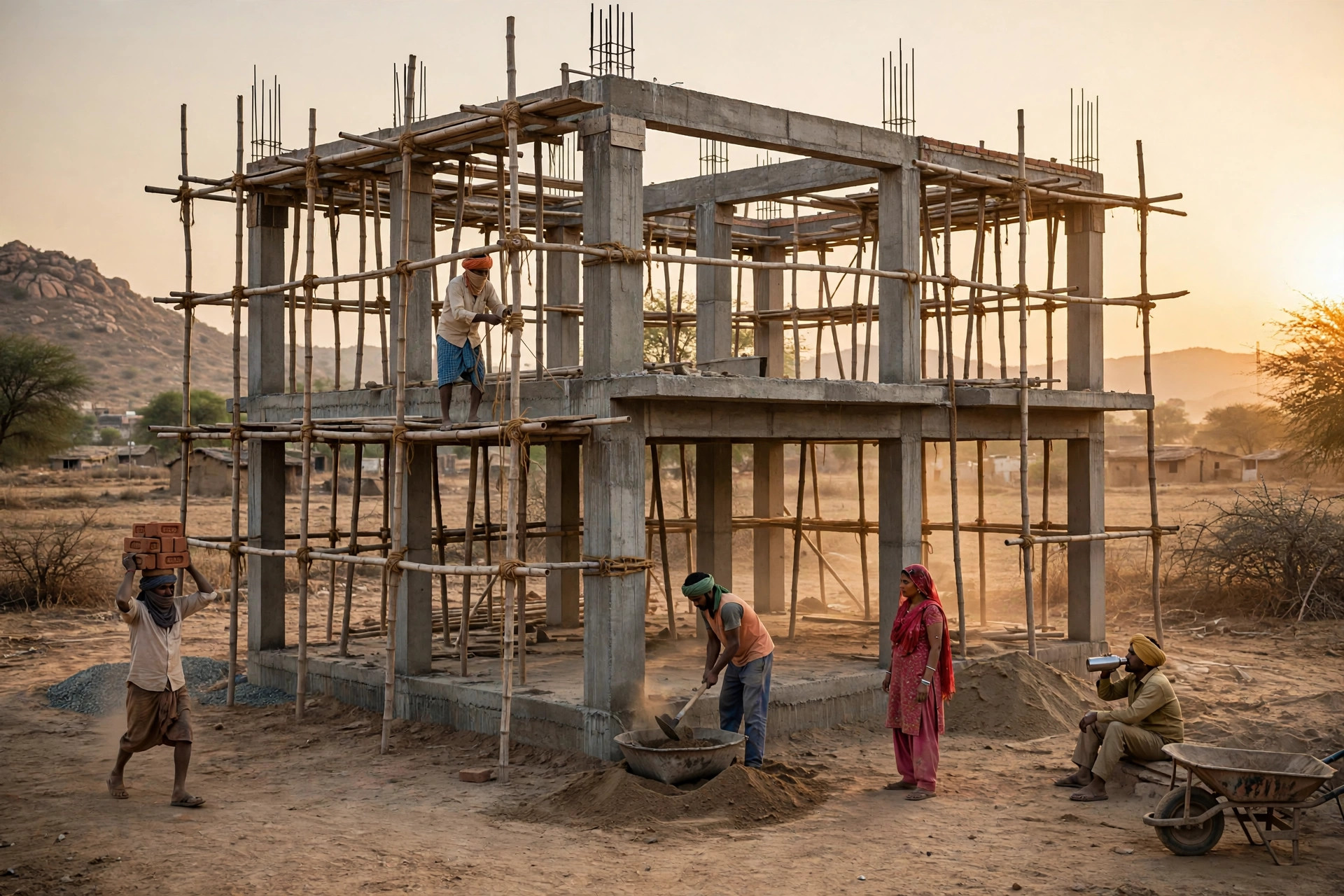
Borewell cost in Ajmer is the one line item in a house budget that nobody can quote properly until the rig is already on the plot. The architect's estimate lists it, the contractor shrugs at it, and the drilling contractor quotes a per-foot rate that turns out to cover only a third of the real bill. In Ajmer the stakes are higher than in most Indian cities: the municipal supply from the Bisalpur project is interrupted for 24 to 30 hours at a stretch during maintenance or low reservoir levels, and a private borewell is, for many households, the only reliable water source through the summer. This guide covers borewell cost in Ajmer for house construction — the 2026 per-foot rates, the depth that actually works in Ajmer's hard rock, the casing, pump and panel costs the per-foot quote leaves out, the permits you need before drilling, and the checks that stop a ₹1 lakh borewell becoming a dry hole.
Short answer: A standard 6.5-inch home borewell in Ajmer, drilled to the 380 ft ideal depth, costs about ₹68,020 for drilling, casing and site logistics in 2026 rate guides. Add a submersible pump (₹18,000–70,000), electrical panel and wiring (₹15,000–40,000) and a hydro survey (₹5,000–15,000), and the all-in budget is roughly ₹1.05–1.95 lakh. The average water level in Ajmer sits at about 310 ft, and the recommended drilling depth is 425 ft for a reliable year-round supply. Get the NOC before drilling, and never pay in full without a measured yield test.
Borewell cost in Ajmer for house construction: the 2026 numbers
Ajmer's 2026 borewell rate guides price drilling by diameter, because diameter decides the rig, the casing and the pump that can fit inside. The four sizes cover everything from a small single-family home to an agricultural or industrial borewell. The figures below are for the ideal depth of 380 ft, and they cover drilling, PVC casing and site logistics only — the pump, panel and survey come on top.
| Borewell size | Best for | Rate per foot | Drilling (380 ft) | Casing + logistics | Total before pump |
|---|---|---|---|---|---|
| 4.5 inch | Small residential, single-family home | ₹95 | ₹36,100 | ₹19,380 | ₹55,480 |
| 6.5 inch | Standard home, flats, shops | ₹109 | ₹41,420 | ₹26,600 | ₹68,020 |
| 7.5 inch | Commercial, large housing society | ₹158 | ₹60,040 | ₹32,680 | ₹92,720 |
| 12 inch | Agriculture, industrial high-yield | ₹193 | ₹73,340 | ₹45,600 | ₹1,18,940 |
For most Ajmer houses, the 6.5-inch borewell is the right choice: it takes a standard 1–1.5 HP submersible pump, it delivers enough flow for a family plus a garden, and it is the size every local driller stocks casing and pumps for. The 4.5-inch borewell saves about ₹12,500 on the drilling bill, but it limits the pump size and the yield, so it suits a small house with modest demand. Going bigger than 6.5 inches for a single house is money spent on diameter you will never use.
Two warnings about these rates. First, they move. In Indore in October 2026, drilling rates jumped from ₹85–95 per foot to ₹145 per foot in 25 days as a dry spell pushed households to drill at once. Ajmer's rates are steadier, but a written quote with a validity date is worth more than a verbal per-foot figure. Second, the per-foot rate is the cheapest number a driller can quote, and it is never the total. The next section is the bill that actually arrives.
What the per-foot rate does not include
JK Cement's 2026 borewell guide puts the realistic all-in cost of a 300–600 ft residential borewell in India at ₹1.5–5 lakh, and the gap between that and the ₹55,000–68,000 drilling total is the equipment. Budgeting only for drilling is, in their words, the most common mistake homeowners make. Here is the full budget for a standard 6.5-inch Ajmer borewell at 380 ft, built from the published component ranges.
| Item | Cost range | What it covers |
|---|---|---|
| Drilling, casing, logistics | ₹68,020 | 380 ft of DTH drilling, PVC casing, rig transport and site work |
| Submersible pump | ₹18,000–70,000 | 0.5–1.5 HP submersible, sized from the yield test |
| Electrical panel and wiring | ₹15,000–40,000 | Starter, dry-run protection, cable, earthing |
| Hydro survey | ₹5,000–15,000 | Resistivity survey to locate the fracture zone before drilling |
| All-in total | ₹1,06,020–1,93,020 | A working borewell, not just a hole |
On top of that, keep a small contingency for the dry bore. If the rig misses the fracture zone and the hole yields nothing, most drillers charge for the drilling done, and you pay again for a second attempt at a different point. A hydro survey costing ₹5,000–15,000 is cheap insurance against a ₹3–4 lakh dry hole — the figure JK Cement quotes for drilling blind. Our guide to house construction cost in Ajmer treats the borewell as a separate line item for exactly this reason: no architect's quote covers it, and anyone who bundles it vaguely is hiding the real number.
How deep should a borewell be in Ajmer?
Ajmer's rate guides give three numbers, and the difference between them matters. The average water level is about 310 ft — where the water table sits in a typical year. The ideal drilling depth is 380 ft — deep enough to stay below the summer drawdown. The recommended depth is 425 ft — the depth the guides suggest when you want a perennial supply that survives a bad monsoon. Drilling to 310 ft and stopping is the false economy: the water is there in February and gone in May, when the level drops and the pump starts sucking air.
But depth is not a guarantee. Ajmer sits on the hard-rock terrain of the Aravalli Supergroup — ancient granite, gneiss, schist and quartzite with almost no primary porosity. Groundwater here does not sit in a uniform layer the way it does in the alluvial plains of Punjab or the Gangetic belt, where 100–300 ft is usually enough. In Ajmer it sits in secondary fractures, fissures and weathered zones, and those fractures are localised: one plot can strike water at 350 ft while the neighbour's borewell at 500 ft stays dry. That is why the guides recommend a professional geophysical survey before drilling, and why high-pressure DTH (Down-The-Hole) hammer rigs are the standard equipment here — rotary rigs built for soft soil cannot cut this rock at a sensible speed.
The practical rule: survey first, drill to the fracture the survey finds, and budget for 380–425 ft rather than the 310 ft water level. If the survey finds a strong fracture shallower, stop there and save the money. If it finds nothing convincing, reconsider the point rather than drilling deeper on hope — in hard rock, deeper does not automatically mean more water.
Permits first: the NOC, dark zones and registration
Drilling a borewell in Ajmer without permission is not a paperwork shortcut; it is a fine and a sealed borewell. Rajasthan's groundwater rules, applied through the Ground Water Department, work in three steps.
First, get a No Objection Certificate before the rig arrives — from the local Ground Water Department office or the District Collector's office. The application needs land ownership records (Jamabandi or Parcha), a site map and identity proof. Second, check the zone. Several blocks in Ajmer district are categorised as over-exploited, or dark zones, where sinking a new borewell for commercial use is prohibited and residential boring is heavily monitored. If your plot falls in one, the NOC may be refused or conditioned, and drilling anyway risks sealing and environmental fines. Third, register the borewell after drilling with Ajmer Nagar Nigam or the village panchayat.
One condition catches first-time builders by surprise: new borewell approvals in urban Ajmer are often linked to a rooftop rainwater harvesting system, so the borewell draws from an aquifer the house is also helping to recharge. That is not red tape for its own sake — it is the only way a hard-rock aquifer keeps yielding. Our guide to rainwater harvesting for Ajmer homes covers the storage tank and recharge pit options, and the recharge pit is the one that feeds your borewell over time. The NOC process is also one more reason to settle the borewell point on the sanctioned plan early: our guide to house plan approval fees in Ajmer explains what the sanctioned drawings should show, and the borewell location belongs on them.
The drilling day: what to check while the rig is on site
A YouTube walkthrough by BuildWise Assurance, filmed step by step at a house site near Coimbatore IT Park, makes the point every site engineer repeats: the quality checks happen during drilling, not after. Once the casing is in and the pump is lowered, you cannot see what went wrong. Five things to watch on the day:
- The point. The drilling point should be the one the hydro survey marked, not the most convenient corner for the rig. Moving it to save the driller an hour of setup can mean missing the fracture entirely.
- The casing. In Ajmer, the top 40–100 ft of weathered rock and soil must be cased — MS casing for the top section, UPVC or PVC below — to stop the hole collapsing and surface water contaminating the aquifer. Incomplete casing in loose soil is one of the commonest failures JK Cement lists.
- The rods. Count the drill rods as they go down. This is the oldest fraud in the business: the meter reading is inflated, and you pay for depth that was never drilled. The Telugu borewell guide circulating on YouTube this year walks through exactly this meter fraud, and the fix is simple — stand there, count, and write the number down.
- The flushing. After drilling, the hole must be flushed clear of debris before the pump goes in. Sand left in the borewell shows up months later as grit in the water and a burnt-out pump.
- The cap. A finished borewell needs a proper cap and a raised collar. An open or loosely covered borewell is a safety hazard for children and an open route for contamination.
Keep the driller on site until the hole is flushed and the casing is verified. A rig that leaves at 6 pm with the pump "to be fitted tomorrow" is a rig you may not see again until you chase it.
The yield test and choosing the pump
The yield test is the step most Ajmer homeowners skip, and it is the step that decides whether the borewell works for 15 years or fails in the first summer. A proper test, as JK Cement describes it, means pumping continuously for 6 to 24 hours, measuring the stabilised discharge rate and watching how far the water level falls. Without it, pump selection is guesswork — and guesswork shortens the borewell's life.
Ask the driller or tester for a written record with four readings from the same reference point: the static water level before pumping, the pumping water level at timed intervals, the test flow in litres per minute, and the recovery level after pumping stops. A worked example from a November 2026 handover guide shows what good readings look like: static level 16 m, pumping level 26 m after 60 minutes, test flow 18 litres per minute — a drawdown of 10 m — and recovery to 18 m twenty minutes after stopping. At 18 litres per minute, a 1,000-litre overhead tank fills in about 56 minutes. Those four numbers are what the pump supplier needs; hand them over and ask the supplier to show the duty point on the pump curve.
Pump choice follows from the test, not from the depth. A submersible pump of 0.5–1.5 HP suits most Ajmer homes, and the correct size is the one that delivers the tested flow against the total head — the vertical lift from the pumping water level to the tank inlet, plus pipe and fitting losses. An oversized pump is the classic mistake: it pulls the fracture dry, the motor runs without water, and it burns out. An undersized pump gives low pressure and never fills the tank. Fit dry-run protection and a voltage stabiliser as standard — motor replacement costs far more than the protection panel — and avoid continuous three to four hour pumping cycles, which drain the fracture faster than it recharges.
Ajmer borewell water quality: test before you drink
A borewell that yields well can still give you water you should not drink untreated. Ajmer's groundwater, leached through mineral-rich rock in a semi-arid climate, commonly carries total dissolved solids above 1,000 ppm, reaching 2,500 ppm in brackish zones — a distinctly salty taste. Fluoride exceeds the permissible limit in localised pockets, notably around Kekri and Nasirabad, and needs specialised filtration. The water is generally hard, with high calcium and magnesium that scale up geysers and plumbing, and nitrate levels run high in some agricultural peripheries.
The rule is simple: test the water, then treat it. A basic lab test covers TDS, fluoride, hardness, nitrate and bacterial contamination, and it costs far less than a single geyser element replacement. For drinking, an RO system is effectively mandatory for Ajmer borewell water. For bathing, washing and gardening, the untreated borewell supply is usually fine — which is why most Ajmer houses run the borewell to the overhead tank for general use and keep a separate RO-filtered line for drinking. Do not assume the neighbour's test result applies to your borewell: two fractures a street apart can carry very different mineral loads.
How to compare two borewell quotes
Never compare two drillers on the per-foot rate alone. Ask both to quote the same scope — the same bore diameter, the same drilling depth, the same casing material and grade, the same casing length and the same test — and check whether the rate changes with depth. A November 2026 handover guide works the arithmetic for 250 ft of drilling and 60 ft of casing: one quote at ₹90 per foot with ₹340 per foot casing, ₹3,500 mobilisation and a ₹4,500 pumping test totals ₹50,900; the other at ₹105 per foot with cheaper casing and a cheaper test totals ₹46,150. The higher per-foot rate was the cheaper job by ₹4,750. The figures are the guide's worked example, not Ajmer rates, but the lesson is Ajmer's: the per-foot number is the least informative figure on the quote.
Get these in writing before the rig arrives: the drilling rate and whether it rises with depth, the casing material, grade and length, the mobilisation charge, the pumping test scope, GST, and what you owe if the bore is dry, if drilling stops early, or if you approve extra depth. A driller who will not put the dry-bore charge in writing is a driller planning to argue about it later. And take two quotes, always — on the same written scope, so the comparison means something.
Mistakes that cost Ajmer homeowners lakhs
Most borewell failures in Ajmer are planning failures, not geology. Drilling without a hydro survey tops the list, followed by incomplete casing, no yield test, an oversized pump fitted "for extra pressure", no dry-run protection, and continuous pumping with no recharge. The failure rarely shows in the first month. It shows in May, when the water level drops, sand appears in the supply, the motor overheats and the yield falls off a cliff — six months after you paid in full.
The cheapest borewell is the one drilled once, at the surveyed point, cased properly, tested properly and pumped with discipline. That means a survey before drilling, a written quote on a fixed scope, a yield test before the pump is ordered, a recharge pit alongside the borewell, and a pump sized from the test readings. It also means budgeting the full ₹1.05–1.95 lakh, not the ₹68,000 drilling figure, and getting the NOC before the rig arrives rather than after the neighbour complains. Before you commit, check the ground itself: our guide to soil testing before construction in Ajmer explains what the soil report tells you about foundations — and the same survey visit is the right time to discuss the borewell point.
Frequently Asked Questions
How much does a borewell cost in Ajmer?
For a standard 6.5-inch home borewell drilled to the 380 ft ideal depth, drilling, casing and site logistics come to about ₹68,020 in 2026 Ajmer rate guides. Add a submersible pump, panel and wiring, and a hydro survey, and the all-in budget is roughly ₹1.05–1.95 lakh. A smaller 4.5-inch borewell totals about ₹55,480 before the pump.
How deep should a borewell be in Ajmer?
Ajmer rate guides put the average water level at about 310 ft, the ideal drilling depth at 380 ft and the recommended depth at 425 ft for a year-round supply. In Ajmer hard rock, water sits in fractures rather than at a fixed depth, so a hydro survey matters more than drilling deeper. Deeper does not automatically mean more water.
Do I need permission to drill a borewell in Ajmer?
Yes. Get a No Objection Certificate from the Ground Water Department or the District Collector office before drilling, and register the borewell with Ajmer Nagar Nigam or the village panchayat afterwards. Sinking a borewell in over-exploited dark zones is prohibited, and new approvals in urban Ajmer are often linked to a rooftop rainwater harvesting system.
Which pump is best for a borewell in Ajmer?
A submersible pump of 0.5–1.5 HP suits most Ajmer homes, sized from the yield test — flow and pumping water level — not from the drilled depth alone. An oversized pump drains the fracture faster and burns out the motor. Fit dry-run protection and a voltage stabiliser, and size the pump from the test readings with the supplier pump curve.
Is borewell water in Ajmer safe for drinking?
Only after testing and treatment. Ajmer groundwater often has total dissolved solids above 1,000 ppm, reaching 2,500 ppm in brackish zones, and fluoride above the permissible limit in areas such as Kekri and Nasirabad. The water is also hard, causing scaling in geysers and pipes. Test the water, then fit RO filtration for drinking.
What should I check before paying a borewell contractor in Ajmer?
Ask for a written drilling record with the drilled depth, casing material and length, and a measured pumping test showing static level, pumping level, flow and test duration. Compare quotes on the same scope — diameter, depth, casing grade and test — and get dry-bore charges, GST and exclusions in writing before the rig arrives.
Book Site Consultation
A borewell is decided once and lived with for twenty years, so it deserves to be decided on paper — with the surveyed point, the depth, the casing specification and the pump size written down — before the rig arrives. Book a site consultation and Design Plus will work out the borewell point, depth and all-in budget against your plot's actual ground conditions, mark the borewell and recharge pit positions on the site plan, and give you an itemised estimate for the drilling, casing, pump and panel — separately, in writing — before you commit to anything. Bring your plot papers and the sanctioned plan, and judge the studio on whether its numbers add up.
Planning a project in Ajmer?
Get a free site consultation with our architects — honest scope, transparent pricing, no obligation.
Book Free Site Consultation