
House Plan Approval Fees in Ajmer (2026): Every Charge, Worked Examples, and How to Pay Less
House plan approval fees in Ajmer (2026): every government charge, the 500 sq m rule, worked totals and the costs people forget.
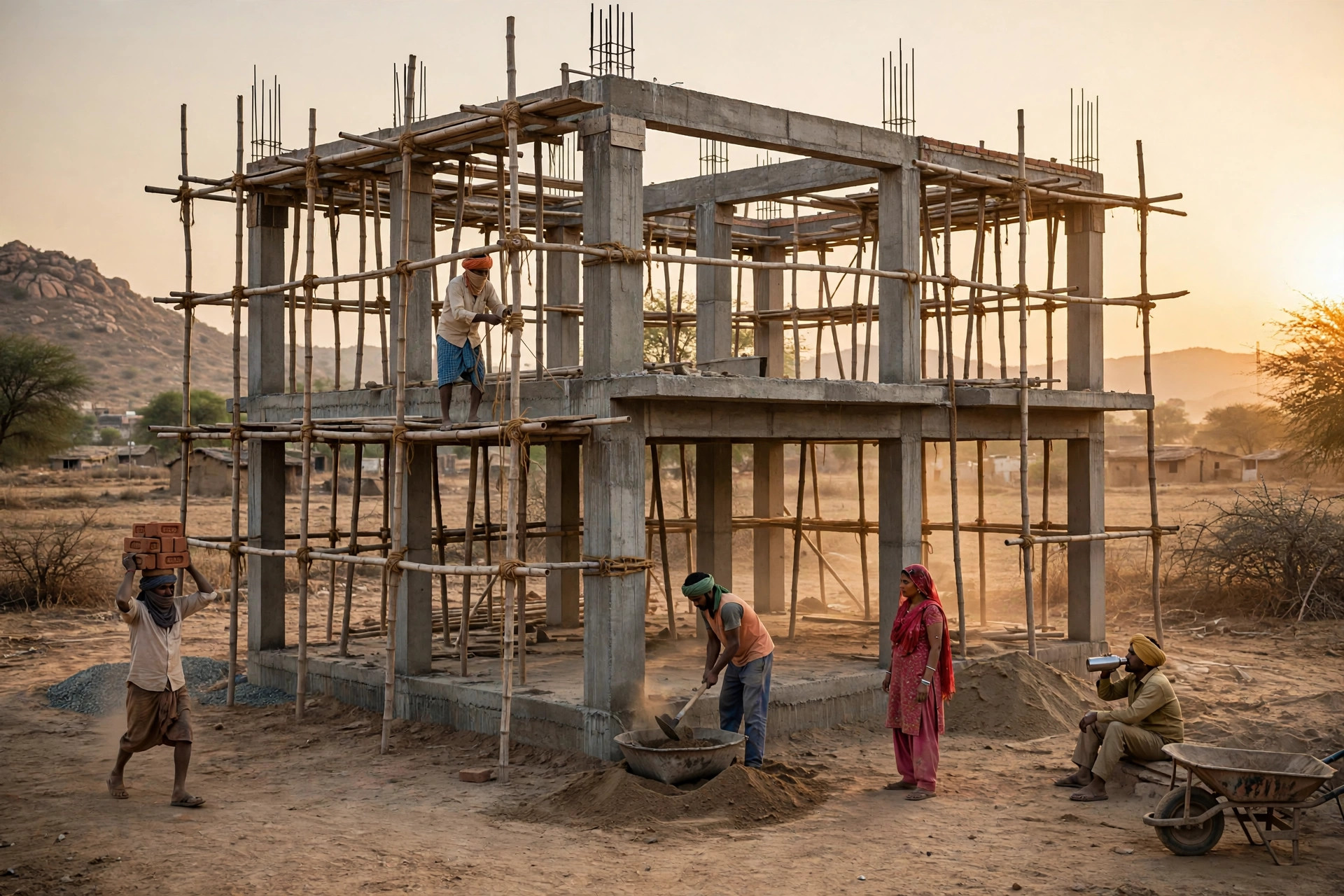
You have the plot, the loan is lined up, and the contractor is asking when he can start digging. Then someone mentions the naksha — and the fees. How much does house plan approval actually cost in Ajmer? The honest answer is that there is no single number: the bill is made of five or six separate charges, it changes with plot size and road width, and the figure your neighbour paid is almost certainly wrong for your plot. This guide breaks down every charge behind house plan approval fees in Ajmer in 2026, works two real examples, and shows the one rule that can remove the approval step entirely for small plots.
Short answer: For a typical Ajmer house, the government charges for plan approval usually total ₹25,000–₹75,000, depending on plot size and road width. That covers the application fee, inspection fee, map approval fee, betterment levy and labour cess — all paid to the authority, not to your architect. And if your plot is up to 500 sq m, Rajasthan's 2025 regulations may let you skip formal map approval altogether and file a certified checklist instead. The architect's design fee is a separate bill, typically ₹35–₹85 per sq ft in Ajmer.
What you actually pay for: the six fee components
Approval fees are not one charge with one receipt. They are a stack, and each layer is calculated differently. Here is what sits inside a typical Ajmer demand, in the order you meet it.
| Fee component | What it pays for | How it is calculated |
|---|---|---|
| Application fee | Registering your file with the authority | A small flat fee per application |
| Inspection fee | The site visit and file scrutiny | Per sq m of plot area, with a cap |
| Map approval (sanction) fee | The approval itself | Per sq m, or floors × plot area × a rate |
| Betterment levy | The authority's charge for the development value your plot gains | A percentage of the area's reserved rate |
| External development charges | Roads, drainage and services serving your area | Zone and road-width dependent |
| Labour cess | The statutory welfare cess on construction work | A percentage of the estimated construction cost |
Two things matter here. First, the first three rows are the predictable part of the bill — they follow a published schedule. Second, the last three rows are where totals swing: the betterment levy and external development charges depend on your zone and the width of the road your plot fronts, which is exactly why the total range for an Ajmer house is as wide as ₹25,000–₹75,000. A plot on a wide arterial road in a new sector and a plot in a narrow old-city lane do not pay the same bill, even if the houses are identical. Our step-by-step naksha approval process guide walks through the documents and the filing sequence behind these charges.
A worked example: the published Rajasthan schedule
Ajmer's ADA and Nagar Nigam set their own demand schedules, and no Ajmer-specific per-sq-m rate sheet is published online — so any post that quotes an exact "Ajmer rate" is guessing. What is published is the Schedule-2 fee table of the Jaipur Building Bye Laws 2020, the reference schedule for Rajasthan's urban bodies, and it shows exactly how these fees are built up. Here is a worked example using that published schedule, so you can see the maths — treat it as an illustration of the method, not as your Ajmer demand.
Take a 200 sq m residential plot with a ground-plus-two-floors house (three floors in total):
| Charge | Calculation | Amount |
|---|---|---|
| Application fee | Flat, per application | ₹200 |
| Inspection fee | 200 sq m × ₹15 per sq m | ₹3,000 |
| Map approval fee | 3 floors × 200 sq m × ₹25 per sq m | ₹15,000 |
| Subtotal before levies | ₹18,200 |
On top of that subtotal sit the betterment levy — 20% of the residential reserved rate for the area under the Jaipur schedule — and the labour cess, which all-India guides put at 1% of the construction cost. Those two additions are what push a small, clean file from under ₹20,000 toward the ₹25,000–₹75,000 band we see on real Ajmer demands. For plots over 500 sq m the schedule changes shape: the approval fee switches to ₹50 per sq m of gross built-up area for residential use (₹75 for mixed or commercial), and the inspection fee for commercial plots runs at ₹45 per sq m, capped at ₹3,00,000. A completion or occupation certificate, where one is required, adds ₹15 per sq m for residential use. The pattern to remember is simple: fees scale with floors and built-up area, so a three-floor house costs roughly three times the approval fee of a single-floor house on the same plot.
What an Ajmer house typically pays in total
Put the schedule maths next to what actually lands on Ajmer demands, and the picture is this:
| House type | Typical statutory outgo | What drives it |
|---|---|---|
| Small single-floor house, narrow lane | ₹25,000–₹35,000 | Low built-up area, low betterment levy |
| Two-floor house, 150–250 sq m plot | ₹35,000–₹55,000 | Extra floor, mid-range zone |
| Three-floor house, wide road / new sector | ₹55,000–₹75,000 | Higher built-up area, higher levy and development charges |
These are statutory charges only — the money that goes to ADA or Nagar Nigam. They are never part of your architect's fee, and any quote that bundles them together without an itemised split should be questioned. If a demand comes back far above this band, ask for the itemised break-up before paying: the usual culprits are a betterment levy calculated on the wrong zone rate, or development charges for a road width your plot does not actually front. For the full picture of what a house costs to build once approval is in hand, see our cost of building a house in Ajmer guide.
The 500 sq m rule: when there is no approval fee at all
The biggest saving in this whole guide is not a discount — it is a rule most Ajmer owners have never heard of. Rajasthan's Urban Development and Housing department issued the Model Building Regulations 2025 on 12 May 2025, and they change the game for small plots. If your plot is up to 500 sq m, or your house has up to 500 sq m of built-up area, you do not need formal map approval at all. You file a checklist — lease deed, site plan with setbacks, height and floors, photographs and affidavits — certified by you and a registered architect or engineer, pay the fees, and the body acknowledges it within 3 days. Setbacks and all other norms still apply; only the approval step drops away.
There are exclusions, and they matter in Ajmer: the checklist route does not apply in a walled city, within 2 km of an airport or in its red zone, within 100 m of an army area, or in special areas. And if your lease deed (patta) has just been issued for a plot up to 500 sq m, approval for ground plus first floor (up to 8 m) can be issued with the lease deed itself. For plots over 500 sq m, the normal online process applies: site report and checks within 15 working days, and approval within 10 working days of paying the demand. An approval, once issued, is valid for 7 years — and a single house needs no completion or occupancy certificate, though flats, group housing and plots over 500 sq m do. Most Ajmer residential plots fall under the 500 sq m line, which is why the first question your architect should ask is not "what will the house look like" but "how big is the plot" — the answer can cut weeks and a whole approval fee out of the project. A YouTube walkthrough by Buildings tips, "Naksha pass ka tarika / Naksha manzori / plan approval / Fee & Documents Required", covers the same ground: which fees apply and which documents the pass needs, before you file.
Who charges you: ADA or Nagar Nigam
Jurisdiction follows your plot's location, and filing with the wrong authority is the commonest avoidable delay in Ajmer. The Ajmer Development Authority governs peripheral zones, new sectors and arterial corridors; Nagar Nigam governs the walled city and central wards. The fee components are the same either way, but the demand schedule and the counter you pay at are not — so confirm which body covers your ward before you budget or file.
You apply online on Rajasthan's Building Plan Approval System, through the SSO portal (sso.rajasthan.gov.in) or the Single Window Clearance System (swcs.rajasthan.gov.in), choosing the development authority, UIT or municipality for your plot. The plan itself must be prepared by a registered professional: a Council of Architecture-registered architect for a plot of any size, with the owner signing too. In Ajmer, the municipal portal accepts plans made through the department's Author Utility, which registered architects and engineers carry — a draftsman's CAD drawing alone will not be accepted. That single requirement is why architect-first projects move faster: the drawings are drawn to the bye-laws from the start, instead of the file bouncing back on setbacks, ground coverage or height.
Government fees vs architect fees — do not mix them up
This is the confusion that costs Ajmer owners the most money, because the two bills arrive at the same time and look like one number. They are not.
Government fees go to ADA or Nagar Nigam. They pay for scrutiny, inspection and the sanction itself. Typical total: ₹25,000–₹75,000 for an Ajmer house, as above.
Architect fees go to your designer. They pay for the drawings, the structural design, the filing and the objection replies. In Ajmer, comprehensive design typically runs ₹35–₹85 per sq ft of built-up area; a basic residential naksha in a small city costs roughly ₹5,000–₹10,000 for the drawing set alone. The two are billed separately, and a professional quote should show them on separate lines. If someone quotes you a single "all-in" figure for design plus approval, ask for the split — the government part is a pass-through cost, and you should be able to see the authority's own receipt for it. Our architect fees guide for Ajmer explains the per-sq-ft, percentage and flat-fee models in full, and our house naksha rate guide shows what each drawing package should contain for the price.
The charges people forget
Even owners who budget the headline fees get surprised by the tail of the bill. These are the ones to watch:
- Betterment levy. Calculated as a percentage of the area's reserved rate, so it tracks land value, not house size. A plot in a high-value zone pays more than the same house in a cheaper zone.
- Labour cess. A statutory percentage of the estimated construction cost — all-India guides put it at 1%. Because it scales with your estimated cost, an inflated estimate inflates the cess too.
- Revision and revalidation fees. Change the plan after sanction and you pay again for the changed portion; let a sanction lapse and revalidation costs a further share of the original fee. Get the design right before filing, not after.
- Fire NOC and other clearances. Not needed for a typical single house, but commercial and multi-storey residential buildings need a fire NOC, which all-India guides price at roughly ₹500–₹5,000.
- The penalty for skipping approval. Build without approval and the authority can stop the work and order demolition. Under the 2025 regulations, work that follows the bye-laws can still be approved afterwards — but with a penalty of ₹90 per sq m of built-up area (₹150 for commercial plots). On a 200 sq m house that is ₹18,000 on top of the normal fees, and anything built against the bye-laws must be removed first. The Kota Development Authority Act adds fines of up to ₹5,000 plus ₹100 a day while unauthorised work continues. The approval fee is always cheaper than the penalty.
How to pay, and how to keep the bill low
Pay through the portal, not in cash at a counter: the demand is generated online after scrutiny, and the receipt is your proof of payment. Keep every receipt — the approval certificate, the fee receipts and the acknowledgement — with the plot papers, because a future buyer, a bank valuing the house for a loan, or a revalidation will ask for them.
Five moves keep the total down:
- Check the 500 sq m rule first. If your plot qualifies, the checklist route removes the approval step and its fee entirely.
- Build to the bye-laws from the first drawing. Revisions after sanction are a second fee; a compliant first submission is the cheapest submission.
- Confirm your zone and road width before budgeting. The betterment levy and development charges hinge on these two facts — get them from the authority, not from a neighbour's bill.
- Keep the estimated construction cost honest. The labour cess is a percentage of it, so an inflated estimate is a tax on yourself.
- File with the right authority the first time. ADA or Nagar Nigam depends on your ward; a wrong filing costs weeks, and weeks cost money.
Frequently asked questions
How much are house plan approval fees in Ajmer in 2026?
For a typical Ajmer house, the government charges for plan approval usually total ₹25,000–₹75,000, depending on plot size and road width. That covers the application, inspection and map approval fees, plus betterment levy and labour cess. The architect's design fee is separate — typically ₹35–₹85 per sq ft — so budget the two streams separately.
Do I need plan approval for a small house plot in Ajmer?
Often, no. Under Rajasthan's Model Building Regulations 2025, a plot of up to 500 sq m, or a house with up to 500 sq m of built-up area, needs only a certified checklist, the fees paid, and an acknowledgement within 3 days. It does not apply in the walled city, near the airport or army areas, or in special zones.
Who approves house plans in Ajmer — ADA or Nagar Nigam?
It depends on where your plot sits. The Ajmer Development Authority (ADA) governs peripheral zones, new sectors and arterial corridors, while Nagar Nigam governs the walled city and central wards. You apply online through Rajasthan's Building Plan Approval System via the SSO portal, choosing the right authority for your plot.
Are architect fees included in plan approval fees in Ajmer?
No. Government approval fees go to the authority — ADA or Nagar Nigam — and pay for scrutiny, inspection and the sanction itself. Architect fees pay your designer for the drawings, structural design and filing. In Ajmer, design fees typically run ₹35–₹85 per sq ft, and a basic residential naksha in a small city costs roughly ₹5,000–₹10,000.
What happens if I build without plan approval in Ajmer?
The authority can stop the work and order partial or full demolition. Under Rajasthan's 2025 regulations, work that follows the bye-laws can still be approved afterwards, but with a penalty of ₹90 per sq m of built-up area (₹150 for commercial plots). Anything built against the bye-laws must be removed first, and an approval obtained on false facts is void.
How long does house plan approval take in Ajmer?
For a compliant file, Design Plus typically sees sanction in 30–45 working days in Ajmer. Under the 2025 regulations, plots over 500 sq m get a site report and checks within 15 working days, and approval within 10 working days of paying the demand. Small plots under the checklist route are acknowledged within 3 days.
Book Site Consultation
Approval fees are the smallest part of a house budget and the easiest part to get wrong — a wrong zone, a missed checklist route, or a revision after sanction can double the bill for no extra house. The cheapest hour of the project is the first meeting, before a single drawing is made. Book a site consultation and Design Plus will check your plot's size, zone and road width against the current ADA or Nagar Nigam schedule, tell you whether the 500 sq m checklist route applies, and give you an itemised estimate of the government fees and the design fee — separately, in writing — before you commit to anything. Bring the plot papers, and judge the studio on whether its numbers add up.
Planning a project in Ajmer?
Get a free site consultation with our architects — honest scope, transparent pricing, no obligation.
Book Free Site Consultation